
HEALTHCARE · PRODUCT DISCOVERY · CO-CREATION
Co-creating a standard for clinical case presentation with dermatologists across Europe
Almirall · 2020–2022
Role: Project Manager & UX Lead
Stakeholders: Scientific Committee (27 dermatologists) · Product & Marketing · CTO · Medical & Legal · PR & Communications
Impact: 200,000+ users · ASPID Prize, Most Innovative Project 2022
Context
Almirall wanted to support dermatologists in presenting psoriasis clinical cases at medical congresses and educational sessions. Presentations were inconsistent, relying on static slides and fragmented materials that made it hard to compare cases or explain treatment decisions.
The challenge
Design a digital tool to present clinical cases in a structured, visual and engaging way, intuitive for dermatologists with different levels of digital skill. Every dermatologist presented cases differently, and no comparable product existed to benchmark against.
In a highly regulated medical environment, this meant balancing clinical accuracy, usability, compliance and scalability.
Strategic approach
Rather than designing for dermatologists, we designed with them. We set up a Digital Scientific Committee of 27 dermatologists across Europe, a continuous source of expertise for discovery, validation and research throughout the project.
Structured clinical storytelling: a consistent format that makes cases easy to compare and discuss.
Visual clarity: imagery and structured data that can be read quickly during a presentation.
Intuitive interaction: simple enough for every level of digital skill, without compromising medical rigour.
The journey
01 / Turned clinical expertise into a co-creation loop.
I structured the collaboration as an ongoing loop: listen to dermatologists’ workflows, prototype a shared experience, let them explore it on their own for several days, interview them, and iterate. After the beta release, remote usability tests and interviews revealed three issues affecting adoption: the case-creation flow lacked clarity, data entry felt time-consuming, and app performance hurt usability.
02 / Prioritised improvements with the committee.
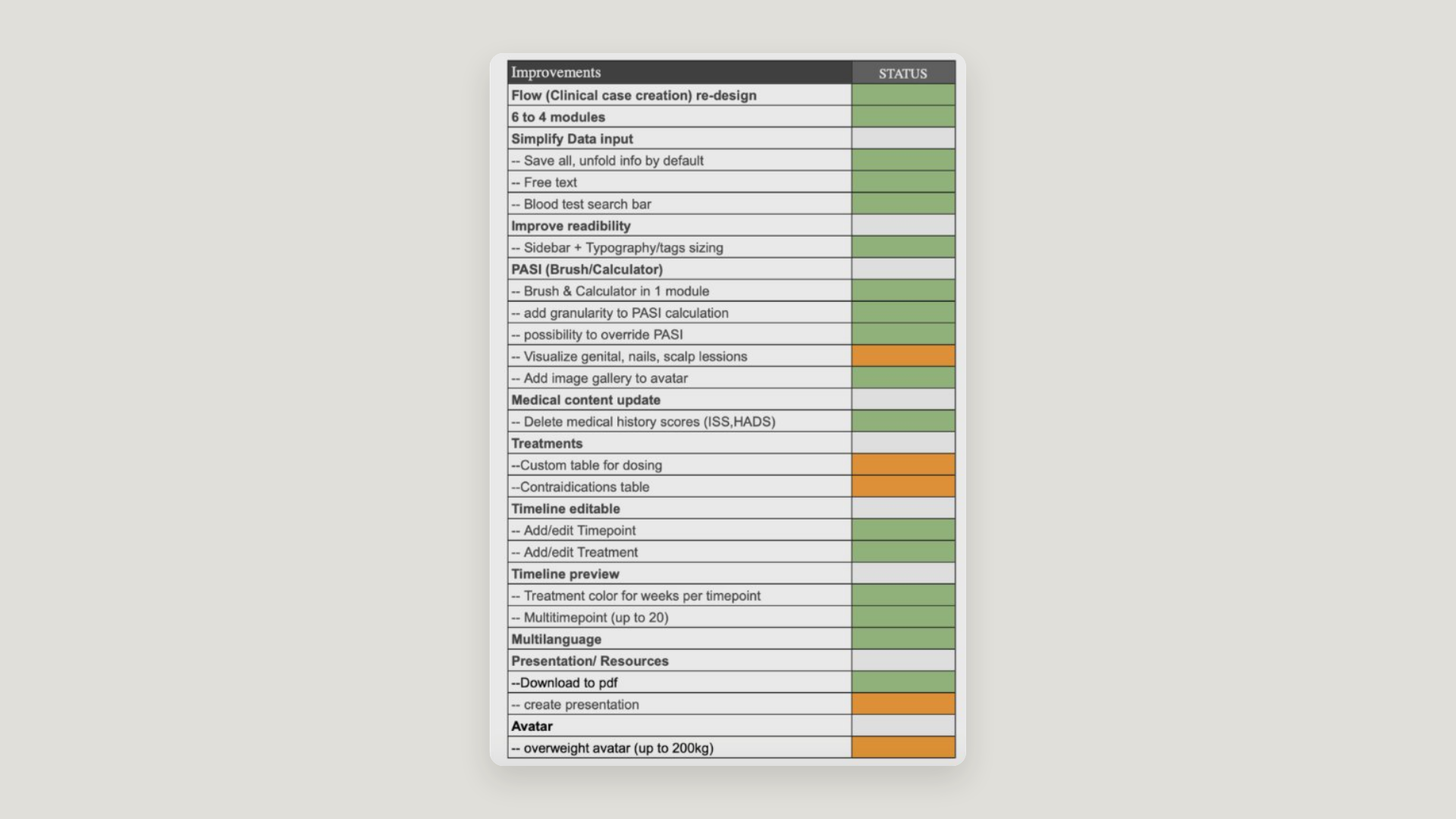
I turned the feedback into a prioritised list of improvements, balancing clinical needs, technical effort and launch timing.
03 / Simplified the case-creation flow.
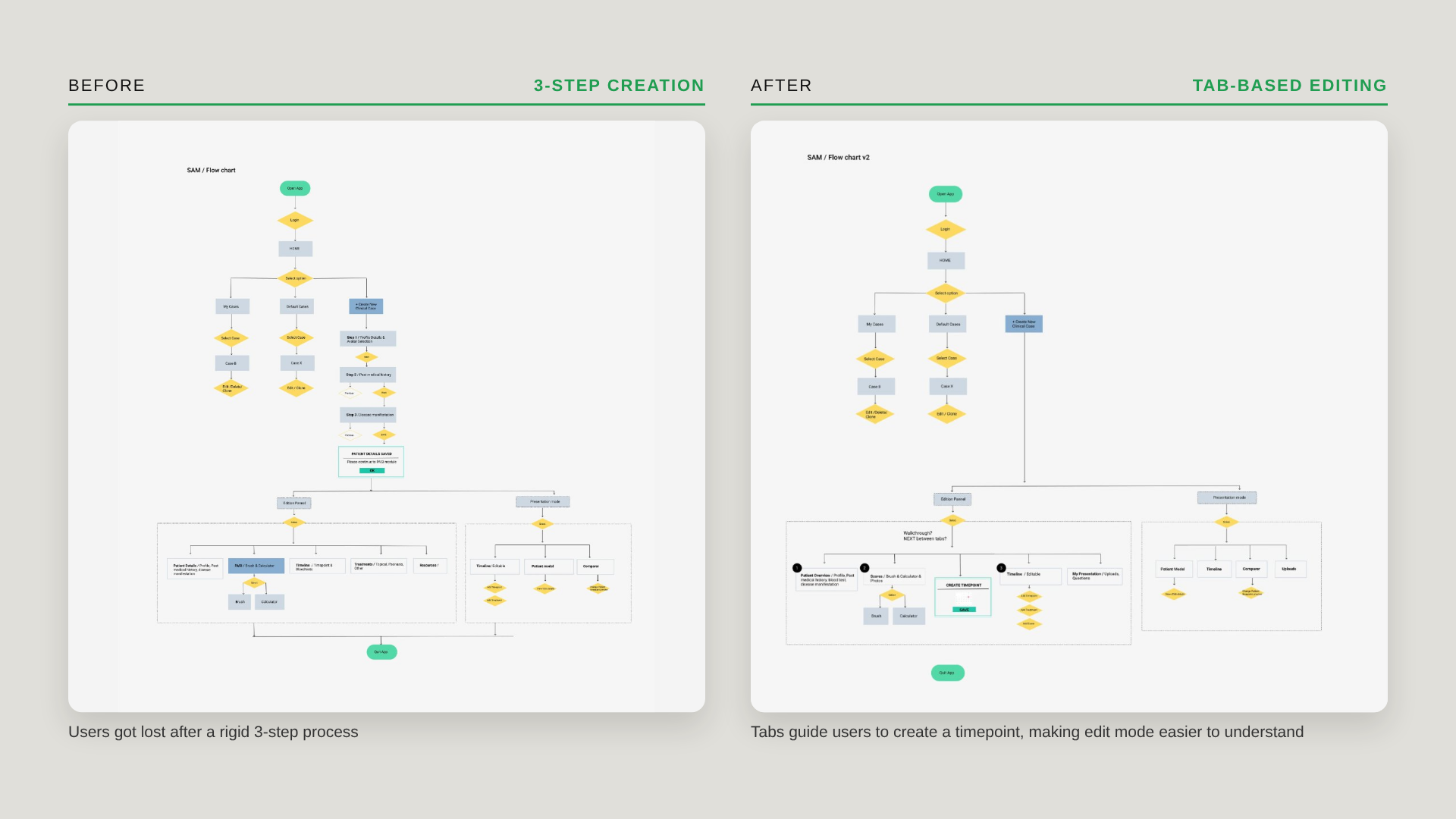
Users got lost after a rigid three-step process. Working with doctors and the medical and communications teams, I removed the three steps and introduced tabs that guide users to create a timepoint. This made edit mode much easier to understand. The flow went from six modules to four.
04 / Reduced input effort without compromising medical rigour.
Creating a clinical case required a lot of manual input, a critical barrier given how little time physicians have:
Long, scroll-based lists of clinical variables were replaced with intelligent search.
Optional free-text fields gave flexibility where needed.
Sections open by default to remove unnecessary clicks.
We validated this by asking dermatologists to create the same clinical case in the new interface and comparing completion times.
05 / Balanced visual quality and performance.
High-resolution 3D avatars and 4K lesion rendering slowed the app down on some devices. Rather than lowering the visual quality, I introduced adaptive performance controls: adjustable resolution (2K / 3K / 4K), device-based detection that optimises automatically, and clear minimum system requirements.
Impact
SAM launched on iOS, Android, Windows and Mac, reaching 200,000+ engaged users.
The project won the ASPID Prize for Most Innovative Project (2022), recognising its contribution to digital tools in dermatology.
The Scientific Committee created a lasting feedback loop between clinicians and product teams, so the experience reflects real clinical workflows.
Reflection
When there’s no product to copy, the users become the benchmark. Bringing 27 specialists into the process turned different practices into one shared standard, and kept clinical rigour and usability in balance at every decision.